
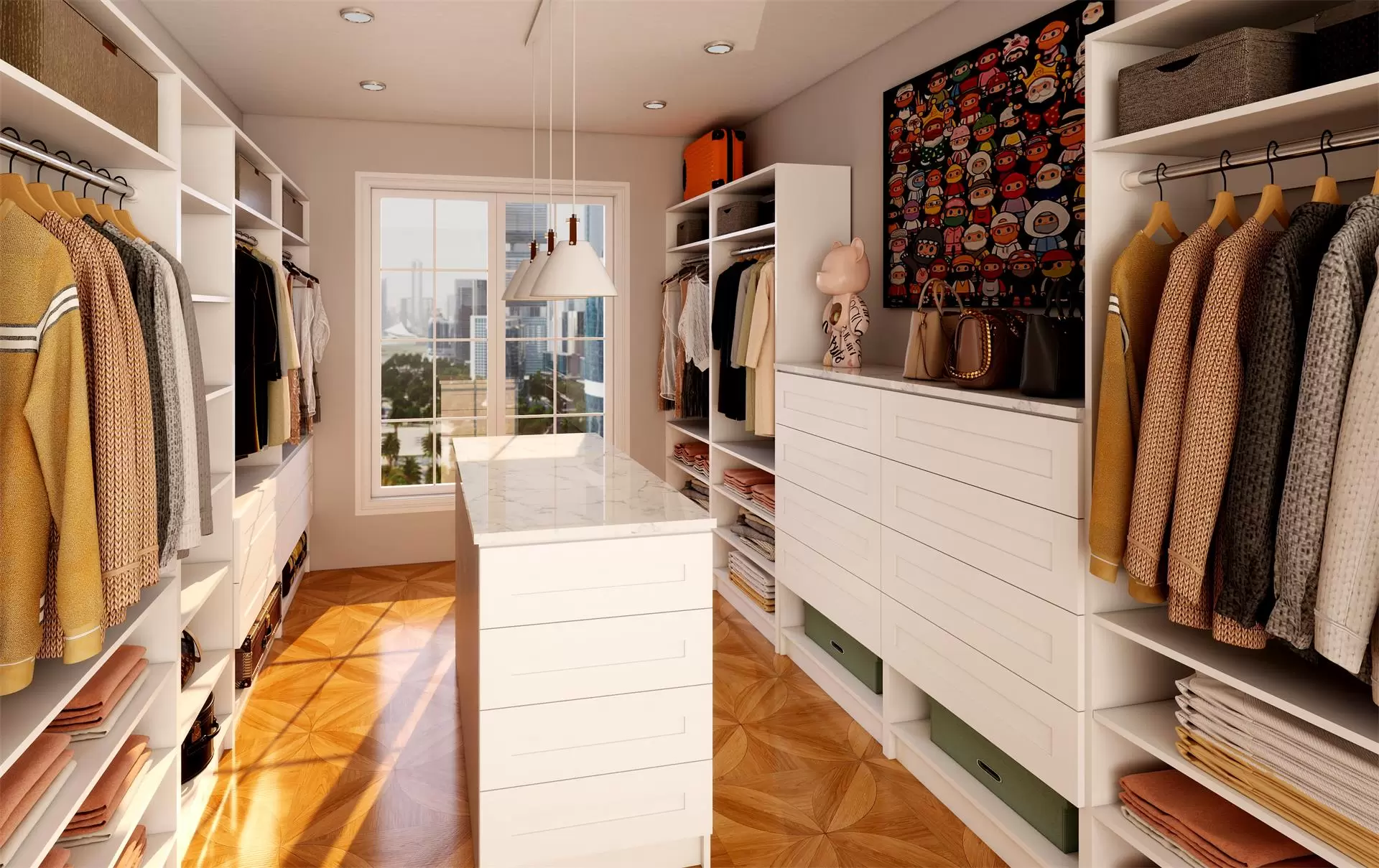
Small closets are not a storage problem. They are a design problem. Most small closets waste 30 to 40 percent of their available space in the same three ways — and all three are fixable.
Waste #1: one hanging rod where you could have two
A single rod at 66 inches leaves a huge empty space above your shirts and below your shoes. Split that height into two rods — one for shirts, one for pants or skirts — and you roughly double your hanging capacity in the same footprint. This is the single highest-impact change in a small closet.
Waste #2: a shelf-to-ceiling gap full of nothing
Top shelves end up holding things people cannot reach. Bring storage up to the ceiling with a tall tower instead. A 16-inch-wide tall tower with shelves holds folded clothes, bins and out-of-season items in vertical space you are already paying for.
Waste #3: drawer-heavy layouts in tight spaces
Drawers are comfortable, but in a small closet they eat floor space and money. You can replace most of them with:
- Adjustable shelves for folded sweaters and jeans
- Shoe shelves at 6–8 inch spacing instead of a shoe rack on the floor
- Woven baskets or bins on shelves for the small stuff — cheap, flexible, and they hide clutter
Five layouts that work in tight closets
- The 48-inch double-hang: one wall, two rods, two top shelves. Fits shirts, pants and shoes for one person.
- The tower plus hang: a 24-inch tall tower with shelves and drawers on one side, double-hang on the other. Best for a 60–72 inch wall.
- The shoe wall: four to six shoe shelves at the base, hanging above. Works when your shoe collection is the space hog.
- The entryway conversion: if a reach-in is too small, a mudroom-style wall in the hallway often stores more than the closet did.
- The corner L: two short walls beat one long wall when you have corners to use.
Make the space feel bigger
Light finishes and open shelving make a small closet read as larger. Dark closed cabinets in a tight space feel like a wall. If you want doors, keep them light and consider glass or a mirror on one unit — the mirror does double duty.
Add storage later, not all at once
The advantage of a modular system in a small closet is that you do not have to solve everything on day one. Start with the hanging and shelving you need, live with it for a month, then add the drawer unit or shoe shelves where the clutter actually piles up.
Start by measuring your wall, then check which short and tall towers fit. If your closet is beyond saving, see the room-based layouts for alternatives like an entryway wall.
Quick checklist
- Split tall hanging into two rods where garment lengths allow
- Store up to the ceiling, not up to arm’s reach
- Swap half your drawers for adjustable shelves and bins
- Use shoe shelves instead of a floor rack
- Keep finishes light
- Leave room to add a drawer unit later