
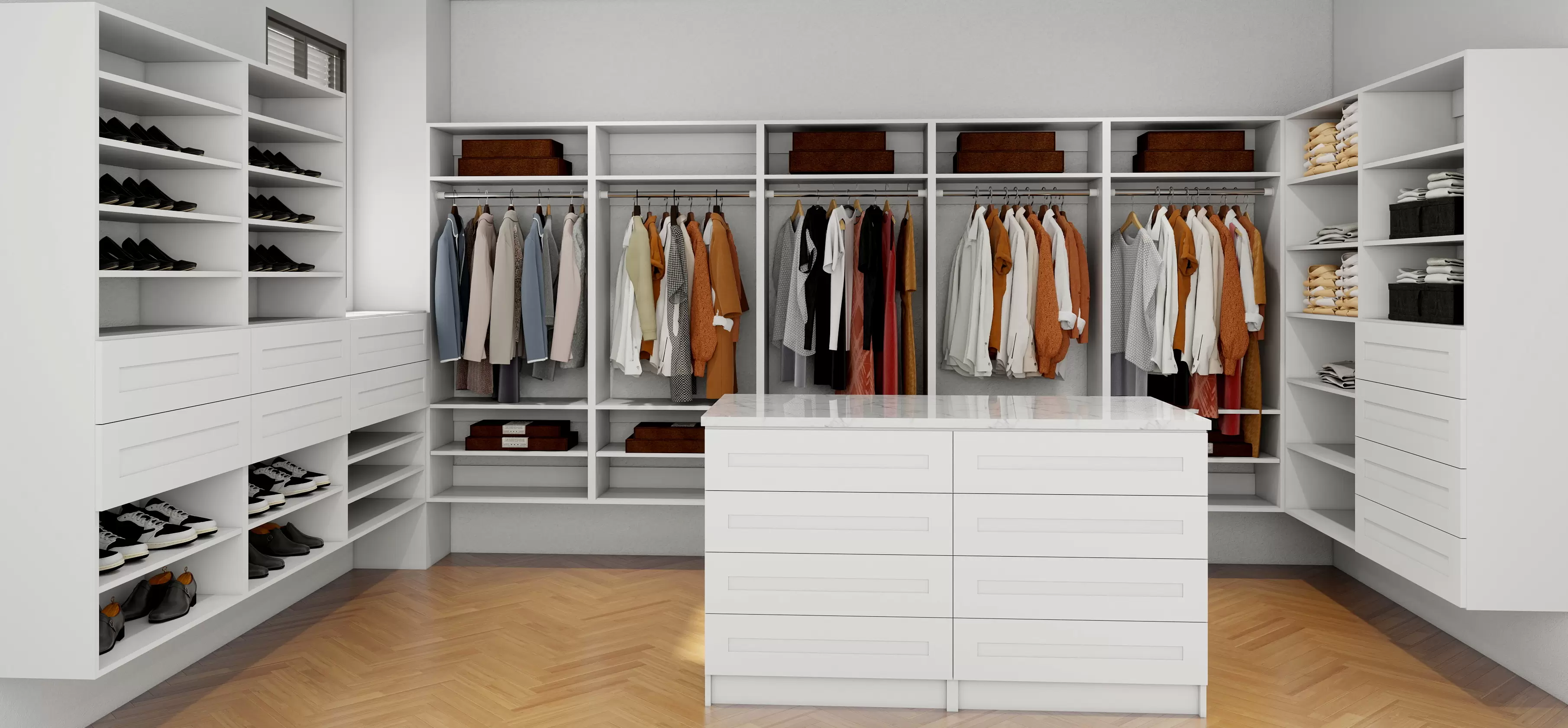
Put a plywood closet system and an MDF closet system side by side in a showroom and most people cannot tell them apart. The difference shows up two years later — in shelves that sag, screws that spin in their holes, and panels that swell after one humid summer. This guide compares plywood vs MDF for closets: how each is made, how each performs in a real bedroom, and how to choose.
What plywood and MDF actually are
Plywood
Plywood is made from thin sheets of wood veneer glued together with the grain of each layer running at a right angle to the layer below it. That alternating direction is the whole point of the material. It gives the panel strength along both axes and limits how much the wood can move as humidity changes.
For closet work, the grade that matters is birch plywood: hardwood face layers over a dense core. It holds a screw at the edge, keeps its shape, and does not need a laminate to look finished.
MDF
Medium-density fiberboard works the other way. Wood is broken down into fiber, mixed with resin, and pressed into a flat panel under heat. The result has no grain and no layers — just uniform density. MDF machines cleanly, paints to a smooth finish, and costs less per sheet than plywood.
What it does not have is internal structure: no cross-laminated plies to spread a load, and no continuous fibers to hold a fastener under daily load.
Plywood vs MDF at a glance
| Factor | Plywood | MDF |
|---|---|---|
| Structure | Cross-laminated veneer layers | Uniform pressed fiber |
| Strength | High — strong in both directions | Moderate — strong flat, weak at edges |
| Screw & cam holding | Excellent, survives re-assembly | Fair — degrades if reused |
| Moisture | Moves slightly, recovers | Swells at exposed edges, stays swollen |
| Weight | Lighter for the same stiffness | Heavy and dense |
| Surface | Wood grain, needs a finish or laminate | Smooth, paints very well |
| Cost per sheet | Higher | Lower |
| Typical life in a closet | 15–25 years | 8–12 years |
Strength and how the panels hold a screw
A closet system is really a set of joints. Every tower, drawer box and shelf connects to something, and each of those connections has to stay tight through years of daily use.
In plywood, a screw bites into alternating layers of solid wood. The plies act like small teeth, so the fastener grips through the panel and into the edge. It also survives being removed and put back, which matters whenever you reconfigure a closet.
In MDF, the screw bites into compressed fiber and resin. It holds fine the first time. Take it out and drive it back into the same hole and the fibers break down — which is why MDF joints loosen fastest after a move or a remodel. The edges are the weak point, because that is where fiberboard has the least material to grab.
This detail matters more than usual in a modular system. A mechanical locking assembly such as QuickLok™ performs only as well as the panel edge it locks into. Panels that hold their edge keep a closet square and rattle-free for the life of the installation.
Moisture, humidity and the edges of the panel
Closets sit in a middle ground — not wet rooms, but not dry either. Coastal and Midwestern summers push indoor humidity above 70 percent. Basement and garage closets, mudroom walls, and units against an exterior wall all sit near cooler surfaces where condensation forms.
- Plywood takes on and releases moisture slowly, and its cross-grain build limits how far the panel can move. A damp spell may leave a little swell at an unprotected edge, but the panel keeps its shape.
- MDF is far more sensitive. Water that reaches the raw edge makes the fiber expand, and it does not shrink back. Once MDF swells it stays swollen, and the finish along that edge cracks.
In a bedroom or a hallway, either material can work. In a basement, garage, mudroom or laundry room — or anywhere against a wall that sweats — plywood is the safer choice and MDF is the one that fails first.
Weight and installation
MDF is heavy. A panel that is easy to paint becomes a panel that is hard to lift into place, especially a tall unit going up near a ceiling. Plywood gives you more stiffness per pound, so tall towers are easier to handle and less likely to bend on the way in.
Weight also shapes how an install feels on site. Most of the labor in a closet project goes into handling, alignment and adjustment, not the fasteners. A system that locks panels together with a purpose-built connector — instead of glue and clamps — compresses that work into minutes per unit.
Cost: up front and over time
MDF wins on the invoice. Plywood costs more per sheet, so a plywood closet will cost more than a comparable MDF one on day one.
The gap narrows when you price the whole life of the closet:
- Replacement: if MDF panels soften or swell inside a decade, you pay for the closet twice.
- Repairs: stripped screws and sagging shelves in MDF are often not fixable in place, because the panel itself is the problem.
- Resale: a built-in closet is part of the room. Buyers look at how it has held up, not at which sheet goods were cheapest.
For a rental you will leave in three years, MDF makes sense. For a primary home, a spec house, or a rental you plan to keep, plywood is usually the cheaper decision once you count the second decade.
Which material should you choose?
The short version, by situation:
- Bedroom walk-in or reach-in on a dry interior wall: either works. Choose plywood if you plan to reconfigure or sell in a few years.
- Basement, garage, mudroom, laundry: plywood. Skip MDF in these rooms.
- Rental you will sell soon: MDF, and keep the layout simple.
- Builder spec or multi-unit project: plywood, because callbacks for sagging shelving and stripped screws cost more than the board does.
- Heavy daily use — shoes, bags, tools, stock: plywood, and ask for solid wood drawer boxes rather than fiberboard fronts.
What STORIQ builds with
STORIQ closet systems are built on birch plywood construction with solid wood drawer boxes, assembled using the QuickLok™ fast-locking assembly system. Panels lock together mechanically, so a tower goes from flat-packed to standing without glue and clamp time.
Browse the modular closet components — towers, drawer bases, shoe shelves and hanging sections — or open the closet system catalog for the full component list and finishes. If you are working to a specific room, start with the room-by-room closet solutions.
Builders, designers and dealers who want to specify STORIQ on projects can request trade pricing through the dealer program.
Quick checklist
- Check the panel edge, not just the surface — that is where closets fail first
- Ask what the drawer boxes are made of; fronts hide a lot
- Match the material to the room: plywood for damp walls, MDF for dry ones
- Expect MDF to be cheaper up front and plywood to be cheaper over ten years
- Look at the assembly hardware — good joints make any panel last longer